Affiliate blogging isn’t what it used to be. You can’t just pick a product, drop in a link, and write a couple of paragraphs around it anymore. Readers have too many options now, search results are crowded, and thin content sticks out fast.
Good affiliate blog writing starts somewhere else entirely: with the reader’s actual question. What do they need to know before they hand over their money?
Get that right, and the affiliate links stop feeling like the point of the article — they become part of the answer.
What Is Affiliate Blog Writing?
At its core, it’s writing blog content that recommends products or services through affiliate links, so that when someone buys through that link, the publisher earns a commission.
That can look like a lot of things — a full product review, a head-to-head comparison, a buying guide, a how-to piece, or just an article that explains how a product solves a specific problem.
But whatever form it takes, the content has to earn its place beyond the link itself.
Google has been fairly blunt about this: it calls out “thin affiliation,” where a page just repeats what the merchant already says with nothing added. The pages that actually hold up offer something more — original opinions, real comparisons, testing, ratings, or just a clearer way to figure out which option makes sense.
Why Helpful Content Matters More Than Ever
Affiliate sites are usually fighting for searches with real commercial intent behind them. Someone typing “best running shoes for beginners” or “best project management software for small businesses” isn’t asking what a running shoe is. They’re weighing options, probably close to buying.
That’s the opening for a well-written article.
Instead of copying spec sheets from manufacturer pages, a good affiliate post helps the reader figure out which option fits their situation and why — not just which one scored highest on a list.
It also lines up with what Google keeps saying about people-first content: write for the person reading it, not for the traffic.
Start With Search Intent
Before you write, figure out why someone is searching in the first place.
Someone typing “how to choose a laptop for graphic design” is still learning what they even need. Someone typing “Dell XPS 16 review” has probably already narrowed it down and just wants confirmation. Those are two different readers, and one article shouldn’t try to be both.
A decent way to work through this:
- Figure out the real question behind the keyword, not just the keyword itself.
- Check related searches and the questions people are actually asking.
- Decide whether the reader is still researching, comparing shortlisted options, or ready to buy.
- Build the article around wherever they are in that process.
This keeps the piece useful instead of turning into a pile of keywords stitched together with no clear point.
Research Keywords Naturally
Keyword research still has a place, but it should shape the article, not dictate every sentence.
An article built around “affiliate blog writing for SEO” will naturally pull in related phrases too — affiliate content writing, affiliate blog posts, product reviews, buyer intent, keyword research, affiliate marketing content — and that’s fine. Those terms help set the context without forcing the main keyword into every other line.
Google’s own SEO guidance says as much: think about the different ways people phrase the same search, rather than fixating on one exact string.
Give Readers Something Original
This is where a lot of affiliate content falls apart.
If ten sites already have nearly the same product description, an eleventh rewritten version doesn’t help anyone. What actually helps is something the reader can’t just get off the merchant’s own page.
That could be honest pros and cons, a real comparison against competitors, a note on who the product isn’t right for, the limitations nobody mentions, a quick buying checklist, or just an answer to the question readers keep asking in the comments.
If you’ve actually used the product, say so — that’s worth more than anything else in the piece. And if you haven’t tested it, don’t write like you have. Readers can usually tell, and pretending otherwise costs more trust than it’s worth.
Write for Decisions, Not Just Clicks
The job of an affiliate article is to help someone decide, not just to get them to click.
Take a comparison of email marketing platforms. Instead of declaring one “the best,” walk through how they actually differ — pricing, how easy each one is to set up, automation features, integrations, and who each one tends to suit. That’s the kind of detail a reader can actually use.
And when the article does that well, the affiliate link stops feeling forced. It shows up at a point where the reader already understands why they’d want to click it.
Keep Affiliate Links Transparent
Don’t hide the affiliate relationship. A simple disclosure lets readers know the publisher might earn something if they buy through a link — and readers generally don’t mind that, as long as they’re told.
Where you place the links matters too. Cramming in extra links just to boost the click count usually backfires; the article starts to read like an ad, and readers notice.
A link earns its spot when the reader already has enough context to understand why it’s there.
SEO Still Has a Role
Good writing alone won’t carry an affiliate article. It still needs a solid structure — a clear title, headings that actually describe what’s underneath them, a straightforward intro, some internal links, and images that are optimized rather than just dropped in.
Internal linking matters especially when the article is part of a bigger content strategy. A shorter, supporting piece can point back to a broader resource, and related posts can lead readers further into the site.
Businesses that need professionally researched, search-focused articles at scale might look at something like SEO Article Writing as the foundation for that kind of strategy.
The Real Goal: Trust Before Conversion
People talk about affiliate marketing in terms of clicks and commissions, but both usually come down to something simpler: whether the reader trusts what they’re reading.
Readers act on a recommendation when the article is upfront about why it exists, admits where a product falls short, mentions the alternatives, and doesn’t oversell.
That’s really the difference between affiliate writing that works and affiliate writing that doesn’t — one reads like guidance, the other reads like an ad.
Final Thoughts
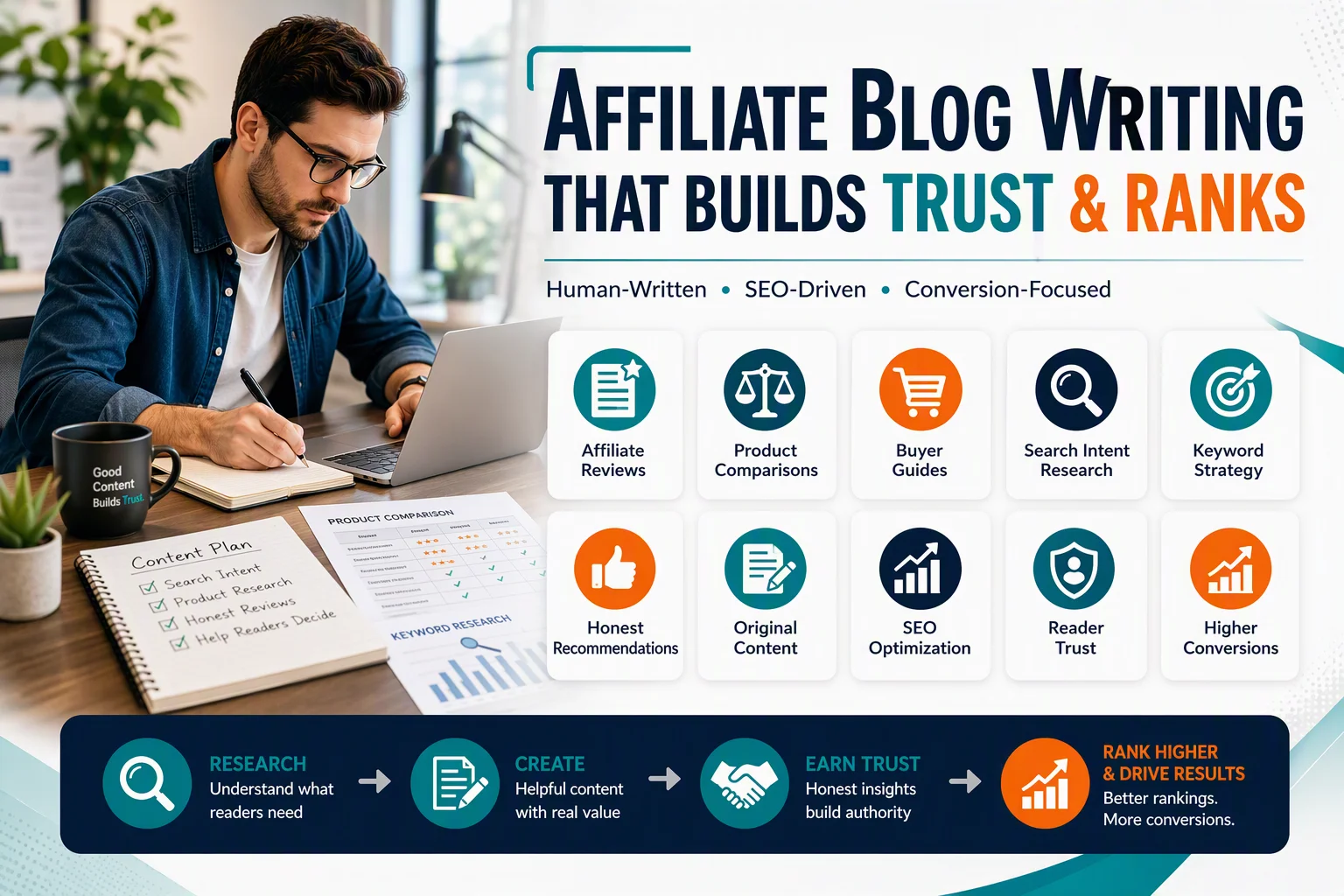
Affiliate blog writing isn’t a numbers game with links. It comes down to building content around real questions, understanding what the reader actually needs at that moment, doing the product research properly, and adding something the reader couldn’t have found on their own.
Put SEO, honest insight, transparency, and genuinely useful recommendations together, and one article can do two jobs at once — bring in the right search traffic and actually help the person reading it make a better decision.
That’s what separates an article that just contains links from one that’s worth reading in the first place.
Usman Javed is a content strategist at Wally Editing Service, where he leads the content and SEO division. He writes about website copy, SEO strategy, and content that actually works for the businesses reading it.