Publishing more articles doesn’t automatically bring more search traffic. A site can have dozens of posts sitting there and still miss the audience it’s actually trying to reach. Usually the problem isn’t a shortage of content — it’s a gap between what a business writes about and what people are genuinely typing into Google. That gap is what SEO article writing is meant to close. It blends useful writing with search intent, keyword research, content structure and on-page optimization so an article is both easy to find and worth reading once someone does find it.
What SEO Article Writing Actually Means
SEO article writing isn’t just adding keywords to an otherwise normal piece of writing. It starts earlier than that — with understanding the topic, the person reading it, and what they’re actually trying to find when they type a search query. The keyword points toward that need, but answering it clearly is the article’s real job.
A good SEO article addresses a genuine question, matches the intent behind the search, explains the subject properly, and uses relevant terms the way a person would naturally say them rather than forcing them in. It reads easily, offers real information instead of padding, and connects sensibly to other pages on the site where that makes sense. None of this means writing for a search engine instead of a person — the point is content that works for both at once.
Why Search Intent Comes First
Two searches on the same general topic can want completely different things. Someone typing “how to improve website speed” is probably looking for a practical fix, something they can act on right away. Someone typing “best website speed optimization tools” is more likely comparing products before deciding what to buy. Same subject, different intent entirely.
Search intent is usually grouped into four rough categories. Informational searches want an answer or explanation. Commercial searches involve someone weighing options before committing. Transactional searches mean the person is ready to act. Navigational searches are simply someone trying to find a specific site or page they already have in mind. Figuring out which one applies before writing a word shapes everything that follows — the format, the depth, the structure the article ends up needing.
Keyword Research Comes Before Writing
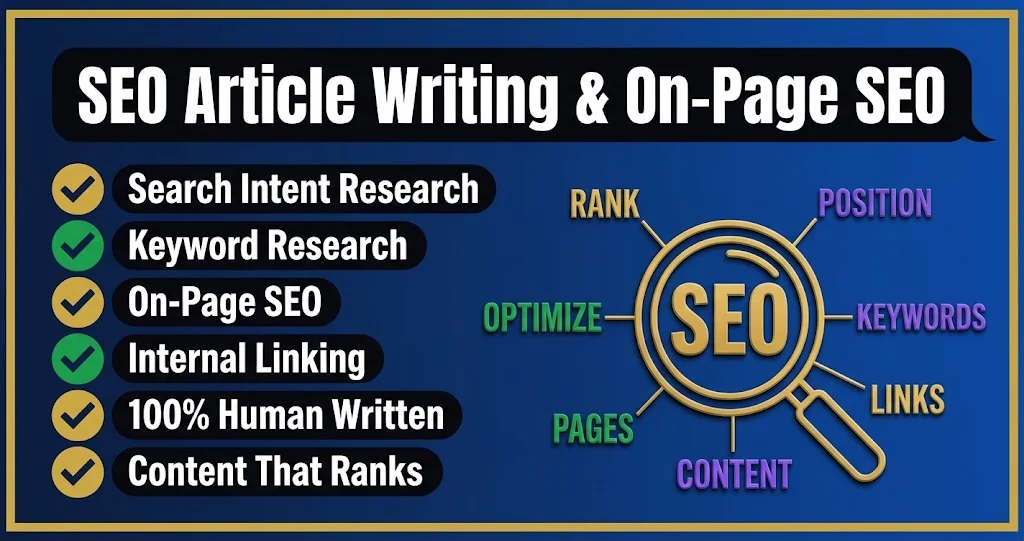
Keyword research isn’t about picking a phrase and repeating it until the article’s done. Done properly, it shows what people actually search for, how they phrase a problem in their own words, and which related questions tend to come up alongside the main one. An article on SEO article writing, for instance, will naturally need to touch on search intent, keyword research, structure, internal linking and on-page SEO — not because those topics pad out the word count, but because a reader can’t really understand the subject without them.
Good research shapes an article. It shouldn’t be steering every single sentence.
Write for People, Not Just Search Engines
Effective SEO writing should sound like something a person actually said, not something assembled from a template. Awkward keyword repetition, overly formal language, paragraphs stretched out just to hit a word count — all of that works against the article rather than for it. The main topic should come through clearly in the title, the opening, the headings and the body, with related terms showing up naturally wherever they genuinely fit.
A decent test for whether this is working: would the article still be worth reading if the person had no idea it was written with SEO in mind? If yes, it’s probably headed in the right direction.
What Makes an SEO Article Actually Effective
There’s no magic word count that guarantees a ranking. What tends to matter more is whether the article is relevant to a real question, useful enough that the reader gets something out of it, and focused rather than wandering off into unrelated territory. Structure counts too — headings and shorter paragraphs make a page easier to navigate, and keywords should sit naturally in the writing rather than sticking out. Bigger claims need something backing them up, and topics that shift over time are worth revisiting rather than publishing once and forgetting about.
How On-Page SEO Supports SEO Articles
Writing the article is only half the job. The page it lives on also needs to be built properly, and that’s where on-page SEO comes in. Depending on the page, that can mean the title tag, heading structure, the URL itself, the meta description, internal links with relevant anchor text, image optimization, structured data where it applies, and making sure the page loads well and works properly on mobile.
None of these elements guarantee a ranking on their own. What they do is help a reader move through the page easily and help a search engine understand what the page is actually about. That’s the real reason SEO article writing and on-page SEO work so well together — the article supplies the information, and on-page optimization makes sure it’s presented and organized in a way that doesn’t undercut all that work.
Internal Linking Matters Too
An article shouldn’t sit on a site as an island. Relevant internal links help a reader find related information while giving search engines a clearer picture of how the different pages on a site connect to each other. An article about SEO writing might link to a guide on on-page SEO. A service-focused piece might point toward the relevant service page. What matters is relevance — links should genuinely help the reader, not exist purely to pad out a link count.
Where Articles Tend to Go Wrong
A handful of mistakes show up again and again. Repeating the same phrase past the point of natural writing turns into keyword stuffing, and it reads as manipulation rather than helpfulness. Ignoring search intent means even well-written content can miss the mark entirely if it answers a question nobody was actually asking. Writing purely to hit a word count rarely helps — an article should be as long as the subject genuinely requires, not longer. Studying competing pages is useful for spotting gaps, but simply restating what’s already out there adds little of value. Unsupported promises about rankings or traffic tend to undermine credibility rather than build it, and publishing something and never revisiting it means it can quietly go stale as products, information, or search behavior shifts underneath it.
Measuring What an Article Actually Does
Publishing is really just the starting point. Google Search Console can show how a page is actually performing — the queries bringing people in, impressions, clicks, and where the page tends to rank. Worth watching alongside those numbers: click-through rate, indexing status, overall organic traffic, and whether the page is generating genuine inquiries. It’s worth remembering that fewer visitors doesn’t always mean a weaker article — a page pulling in the right audience can matter more than one pulling in a larger, less relevant one.
SEO Article Writing in the Age of AI Search
Search itself keeps shifting, with Google rolling out AI Overviews and AI Mode into results. That doesn’t mean SEO fundamentals have gone anywhere, though — Google’s own guidance still points toward useful, relevant content and the same established practices for how its AI experiences pull information. The practical takeaway for a website owner is simple enough: don’t chase every new trick that shows up. Focus on creating something genuinely useful that answers a real question.
SEO Is a Long Game
SEO article writing rarely produces overnight results, and it’s worth saying plainly rather than promising otherwise. A new page needs time to get crawled and indexed, and how it performs after that depends on competition, demand, content quality, site structure, and shifts in how people search. Some articles gain traction quickly. Others take longer, or need a round of improvement before they really start pulling weight. The better approach is publishing something genuinely useful, watching how it performs, and refining it when the data points to an opportunity.
The Bottom Line
SEO article writing was never really about filling a page with keywords. It’s about understanding what people are searching for, why they’re searching for it, and giving them a genuinely useful answer. The strongest work combines search intent, real keyword research, writing that reads naturally, clear structure, on-page SEO, and thoughtful internal linking. When those pieces come together, an article stops being just another blog post and becomes something that actually brings the right people to a website and helps them understand what it offers.
If your site needs well-researched, naturally written SEO articles instead of keyword-heavy filler, Wally Editing Service’s SEO Article Writing Service is built around exactly that — content with a clear purpose from research through to the finished page.
Wally Editing Service — Concept to Completion.